
When Does a Rescue Attempt Become a Separate Basis for Liability?

“Rescue liability” is not one question. It is at least two, and they run in opposite directions. The first asks whether the person who created the original danger is responsible for injuries suffered by someone who tried to help. The second asks whether the person who tried to help can be independently responsible for making the original victim worse. A rescue attempt can remain part of the foreseeable consequences of the original tort while simultaneously creating a separate negligence inquiry directed at the rescuer, and a case built on this doctrine has to keep both questions analytically distinct rather than treating “rescue” as a single, undifferentiated event.
The Rescue Doctrine Extends the Original Causal Chain
The traditional rescue doctrine begins from foreseeability: danger invites rescue. Where a defendant’s negligence creates a situation of peril, the resulting duty extends not only to the original victim but to a person who is reasonably injured attempting a rescue necessitated by that danger, and the doctrine protects the rescuer from the usual contributory-negligence and assumption-of-risk defenses so long as the rescue itself was not reckless or foolhardy. Pennsylvania recognizes the doctrine as establishing a causal relationship between the original negligence and injuries sustained during a rescue attempt, but the Pennsylvania Supreme Court has also made clear that the doctrine does not eliminate superseding-cause analysis; in Bole v. Erie Insurance Exchange, the Court held that an extraordinary, unforeseeable event can still break the causal chain even where a rescue is involved. New Jersey follows a comparable approach, grounding the doctrine in ordinary duty and foreseeability principles and recognizing that the causal chain ordinarily continues through a rescue unless later conduct so completely supersedes the original wrong that the first actor’s negligence no longer materially contributes to the injury. Neither state treats the rescue doctrine as automatically severing responsibility once a rescue begins, and neither treats a rescue as automatically extending liability without limit; the doctrine simply confirms that rescue itself is usually a foreseeable event set in motion by the original danger.
A Rescue Can Also Create an Entirely New Duty
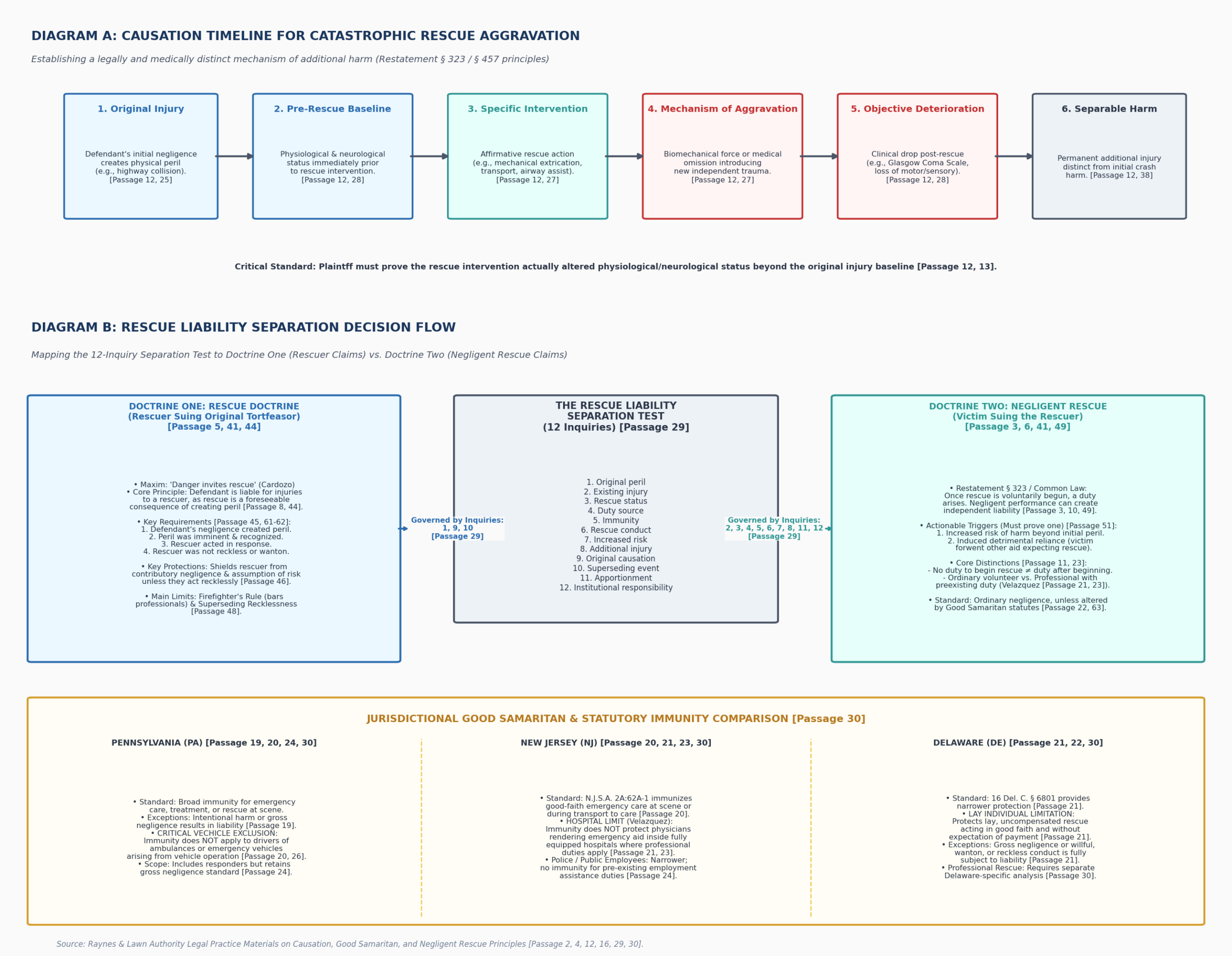
Separate liability becomes more plausible once someone actually undertakes to provide protection or assistance, because undertaking a rescue can create a duty that did not previously exist. Pennsylvania has expressly adopted Restatement (Second) of Torts § 323: a person who undertakes, gratuitously or for consideration, services recognized as necessary for another’s protection may be liable for negligent performance that either increases the risk of harm or causes harm because the injured person relied on the undertaking. The Pennsylvania Supreme Court reaffirmed that § 323 remains part of state law as recently as 2019. This produces an important distinction that a case theory has to preserve: there is ordinarily no duty to begin a rescue, but a duty can arise once the rescue has actually begun. A failed rescue attempt is therefore not automatically negligence. The governing question is narrower: did the rescuer’s own conduct place the injured person in a worse position, increase the risk they faced, or induce reliance that displaced other available help.
Failure to Improve the Victim Is Not the Same as Causing Additional Harm
This distinction matters for defense credibility as much as for the plaintiff’s case. If an injured person would have suffered the same permanent outcome regardless of the rescue attempt, a poor result after rescue does not by itself establish that the rescue caused it. A defensible rescue-based claim needs to trace a specific sequence: the original injury, the person’s physiological or neurological condition immediately before the rescue began, the specific intervention at issue, the mechanism by which that intervention allegedly increased harm, an objective measure of deterioration, and a permanent injury separable from what the original event alone would have caused. For a claim that negligent extrication worsened an unstable spinal injury, the operative question is not simply whether the patient was moved incorrectly. It is whether that movement measurably changed neurological function beyond what the initial collision had already produced, a medical and biomechanical causation question rather than an inference drawn from a bad outcome.
The Original Tortfeasor May Remain Responsible for Harm Introduced During Rescue
This is probably the most important doctrinal complication in this area, because it means separate liability for a rescuer does not automatically release the original wrongdoer. Restatement § 457 provides that an actor responsible for an initial injury may also be responsible for additional harm resulting from normal efforts by third parties to render reasonably required aid, even where those efforts are negligently performed. Pennsylvania follows this principle: in Buttermore v. Aliquippa Hospital, the court explained that an original tortfeasor can remain liable for additional injury from subsequent negligent treatment, while the original wrongdoer and the later provider may have breached separate duties at different points in time. New Jersey’s appellate courts have stated the same underlying concept, that an initial tortfeasor generally remains responsible for the naturally flowing consequences of subsequent medical treatment, including negligently rendered treatment the original injury necessitated. Delaware’s Supreme Court cited § 457 as recently as 2024 in explaining why a reasonably foreseeable intervening act generally does not become a superseding cause. The practical consequence is that “separate liability” for a rescuer does not necessarily mean “separate causation” for the original tortfeasor; both can remain legally responsible for overlapping consequences of the same event.
A Superseding Rescue Event Requires More Than Ordinary Negligence
The defense will sometimes argue that a rescue was so abnormal that responsibility shifted entirely away from the original actor, and that theory deserves careful, not reflexive, treatment. Pennsylvania’s Bole decision states the test clearly: a superseding cause requires conduct so extraordinary that it was not reasonably foreseeable, not merely a rescue performed imperfectly. New Jersey applies a comparable standard, severing the causal chain only where later negligence so completely supersedes the original wrong that the later conduct alone produces the injury. An ordinary, if imperfect, rescue complication is not automatically a new superseding cause; an extraordinary, independent event may raise that question, but the two should not be conflated.
Good Samaritan Statutes Materially Change the Governing Standard
An article or case theory should never simply state that Good Samaritan laws protect rescuers from lawsuits, because the actual statutory rules differ considerably by jurisdiction, by who is doing the rescuing, and by where the rescue occurs. Pennsylvania’s current statute provides broad immunity for good-faith emergency care, treatment, or rescue at an emergency scene, including for emergency-response providers, with liability preserved for intentional harm or gross negligence; the statute also specifically does not relieve the driver of an ambulance or other rescue vehicle from liability arising from the vehicle’s operation, a clear statutory example of a rescue generating a distinct basis for liability even where the underlying rescue effort itself would otherwise be immunized. New Jersey’s N.J.S.A. 2A:62A-1 provides good-faith immunity for emergency care rendered at the scene of an accident or emergency or during transport, but the New Jersey Supreme Court held in Velazquez v. Jiminez, 172 N.J. 240 (2002), that this immunity does not extend to a physician responding to an emergency inside a fully staffed and equipped hospital, reasoning that the statute exists to encourage aid to those who might not otherwise receive it, not to displace the ordinary standard of care owed by medical staff already present for that purpose. New Jersey’s legislature responded directly to that decision, enacting N.J.S.A. 2A:62A-1.3 in 2004 to create a separate immunity specific to in-hospital emergencies, so the current landscape in New Jersey is more layered than Velazquez alone suggests, and any current matter should be evaluated against that later statute as well. Delaware’s rule is narrower still: 16 Del. C. § 6801 protects a lay individual acting in good faith without expectation of compensation, with liability preserved for gross negligence or willful, wanton, or reckless conduct. None of these three statutes should be treated as interchangeable.
Professional Rescue Is Not the Same as Volunteer Rescue
Statutory immunity frequently depends on whether the rescuer already carried a professional or institutional duty before the emergency arose. Velazquez illustrates the point directly: Good Samaritan protection was designed for the unexpected emergency encountered by someone with no preexisting relationship to the patient, not for a professional performing duties within their existing role and setting. The same logic runs through Pennsylvania’s exclusion of emergency-vehicle operation from its immunity statute; an ambulance driver’s underlying duty of careful operation is not converted into a volunteer’s reduced standard of care merely because the driver is also engaged in a rescue. The word “rescue” describes the event. It does not, by itself, determine which standard of care governs it.
The Rescue Liability Separation Test
A disciplined analysis of any alleged rescue-related injury works through a consistent sequence: who created the original peril and through what conduct; what catastrophic harm had already occurred before the rescue began; whether the rescuer was a volunteer, a professional responder, or an institutional employee already carrying a duty; whether that duty arose from an existing role or from a voluntary undertaking; whether a Good Samaritan or public-entity statute alters the governing standard; what specific act or omission is alleged to be negligent; whether the intervention actually increased the risk the person faced; what new or measurably aggravated harm resulted; whether the original tortfeasor remains responsible for that harm as a foreseeable consequence of the initial wrong; whether the later conduct was extraordinary enough to raise a superseding-cause question; whether the original and subsequent injury can be medically separated; and whether institutional factors, protocols, training, staffing, equipment, or dispatch, contributed to what happened. That sequence, not a single question about whether the rescue “went wrong,” is what actually determines whether a separate basis for liability exists.
Qualification and Disqualification Criteria
A matter involving rescue-related aggravation of a catastrophic injury may warrant disciplined review where the available record supports the following:
- A documented original peril and a rescue response to it, with objective evidence of the injured person’s condition immediately before the rescue began.
- A specific rescue intervention, and a medically supported mechanism by which that intervention plausibly increased the risk of harm or caused measurable additional injury.
- An analysis of which duty source applies, whether the rescue doctrine, a voluntary undertaking under Restatement § 323, or an existing professional or institutional duty, and whether an applicable Good Samaritan or public-entity statute changes the governing standard.
- A causation record capable of separating harm attributable to the original event from harm attributable specifically to the rescue, since the severity of the ultimate outcome does not by itself identify its mechanism.
- A jurisdiction-specific analysis, since Pennsylvania, New Jersey, and Delaware apply meaningfully different Good Samaritan statutes, undertaking doctrines, and superseding-cause standards.
A matter does not ordinarily warrant advancement where the alleged rescue conduct amounts only to a failure to improve the victim’s condition without evidence of increased risk or additional harm, where applicable Good Samaritan immunity squarely covers the conduct at issue, or where the claim rests on the severity of the outcome alone without a record connecting that severity to a specific, separable rescue-related mechanism.
Litigation Readiness
Defense positions in this category of case commonly include the argument that no genuine duty ever arose because the rescue was never actually undertaken in the legal sense, that the rescuer’s conduct fell within the scope of an applicable Good Samaritan immunity, that the alleged additional harm reflects the severity of the original injury rather than anything the rescue changed, or that the rescue was so extraordinary or reckless that it constitutes a superseding cause severing the original tortfeasor’s responsibility. A responsible evaluation anticipates each of these positions and keeps the two underlying doctrines, the rescue doctrine and negligent-undertaking liability, analytically separate throughout, since collapsing them into a single theory is exactly where a case becomes vulnerable to challenge.
Scope and Responsibility
The question a rescue-related catastrophic injury raises is not whether the rescue succeeded. It is which duty applies to which actor, whether that duty was breached, whether the breach increased risk or caused measurable additional harm, and whether the original tortfeasor remains responsible for that harm as a foreseeable consequence of the danger it created. This inquiry sits within the firm’s broader work on catastrophic injury litigation and wrongful death litigation, and it frequently intersects with institutional and medical negligence analysis where the rescue itself was performed by EMS, hospital staff, or another institutional actor rather than a bystander.
Referral and Case Review Inquiries
Raynes & Lawn evaluates a limited number of matters involving serious injury, institutional failure, and legally supportable theories of liability. Reviews are conducted to determine whether the medical, technical, and legal foundations required for responsible litigation are present.
Submissions may be made by individuals, families, or referring counsel. Any review is a threshold evaluation only and does not constitute acceptance of representation.
Request a Case Review