
Can a Defendant Benefit From an Incomplete Accident Reconstruction?

Yes, a defendant can benefit from an incomplete accident reconstruction, but the mechanism matters. The benefit does not come from a rule that evidentiary gaps favor defendants, and it does not come from a defendant manufacturing uncertainty or profiting from evidence it had a duty to preserve. It comes from the ordinary structure of civil litigation: the party bearing the burden of proof on a disputed issue bears the cost when the evidence cannot reliably resolve it. An incomplete reconstruction does not create facts for either side. It defines the limits of what can responsibly be proved, and the disciplined inquiry is why the reconstruction is incomplete, which conclusions the surviving evidence actually supports, and who bears the burden on the issue that remains unresolved.
Reconstruction Answers Several Independent Questions, Not One
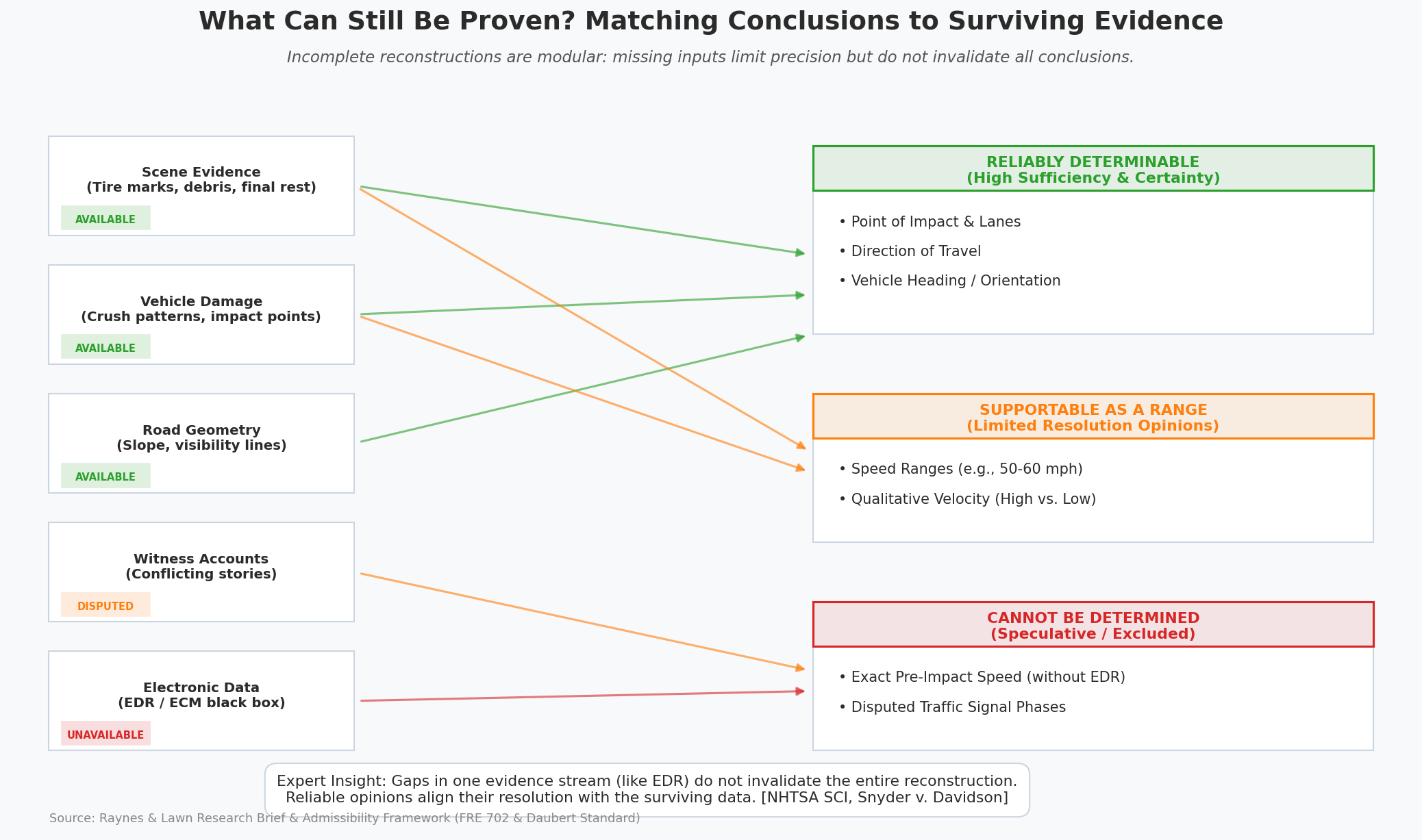
A catastrophic-collision reconstruction typically addresses multiple, separable questions: where impact occurred, which vehicle occupied which position, direction of travel, whether braking was initiated, a supportable speed range, post-impact movement, and whether a mechanical failure contributed. The absence of sufficient evidence for one of these questions does not necessarily eliminate a reliable answer to another. In Snyder v. Davidson, a federal court in the Western District of Pennsylvania permitted a reconstructionist to testify to impact orientation and vehicle travel direction, conclusions supported by police records, deposition testimony, photographs, and vehicle damage and rest positions, while excluding his conclusions about which traffic signal was red and who was at fault, since those propositions depended on resolving disputed witness credibility rather than on a technical methodology. A reconstruction can be reliable in part and unsupported in part, and the disciplined response to an incomplete record is rarely to accept or reject the whole of it.
Missing Precision Does Not Always Mean Missing Proof
Available evidence can sometimes support a qualitative or range-based conclusion even where it cannot support an exact number. In Laugelle v. Bell Helicopter Textron Inc., the Delaware Superior Court addressed a crash that occurred on water, where investigators lacked several of the physical indicators ordinarily used in land-based velocity calculations. The court nonetheless permitted a properly grounded expert opinion distinguishing high-velocity from low-velocity impact based on wreckage condition and accepted methodology, while recognizing that a precise numerical calculation was considerably more difficult on that record. The court was explicit that evidentiary weakness from missing physical evidence is not an excuse for unreliable testimony, but it found the surviving wreckage evidence sufficient to support the more limited, qualitative conclusion actually offered. The resolution of an opinion should match the resolution the evidence can actually support; a properly qualified range or threshold conclusion can be more defensible than an unsupported precise figure, and an expert who claims more precision than the data allow has already created a vulnerability.
The Defendant Benefits From the Burden of Proof, Not From a Presumption Favoring Defendants
Catastrophic injury alone does not establish negligent operation or causation. The Third Circuit’s decision in Oddi v. Ford Motor Co. illustrates the point directly: the plaintiff suffered devastating injuries in a collision, but the court excluded the proposed engineering and reconstruction testimony because the expert’s conclusions rested on insufficiently reliable analysis, and without admissible expert proof the plaintiff could not establish the required elements of the claim, resulting in summary judgment. The court was explicit that catastrophic injury does not itself establish legal responsibility for it. A defendant does not necessarily prevail because evidence happens to be missing; a defendant may prevail because the evidence that does exist does not permit the party carrying the burden to establish a required element without speculation. That is a narrower and more defensible proposition than a general rule that gaps favor defendants, and it is the one supported by the case law.
The Same Reliability Standard Cuts Both Ways
The burden-of-proof principle runs in both directions, and this is where the analysis should not be allowed to become one-sided. Federal Rule of Evidence 702 requires the proponent of expert testimony, plaintiff or defendant, to establish that the opinion rests on sufficient facts or data, reliable methods, and a reliable application of those methods to the case. If the evidence cannot reliably establish speed, braking, lane position, or a mechanical cause, a defense expert is not entitled to fill that same gap with an equally unsupported alternative theory merely because the defense does not carry the burden on the underlying claim. Snyder illustrates this symmetry as well: the reconstructionist could rely on damage and rest-position evidence to reach certain technical conclusions, but he could not use his expert designation to resolve a disputed question of witness credibility regardless of which party’s theory that credibility determination happened to favor. An evidentiary gap is uncertainty, not affirmative proof of whichever theory is more convenient for the party without the burden.
Later Reconstruction Remains Possible After the Original Scene Is Gone
An incomplete original scene investigation does not necessarily end reliable reconstruction. In State v. LaBrutto, the New Jersey Supreme Court addressed a reconstruction expert who worked from photographs, police reports, and a later site inspection to challenge conclusions drawn from the original investigation; the case also illustrates the limits of that approach, since a separate reconstruction witness criticized reliance on photographs alone where tire marks, scuff marks, and debris had not been independently observed by the later expert. The broader principle, consistent with how transportation-crash investigation methodology generally works, is that reconstruction draws on convergence across multiple evidence streams, including scene photographs, police measurements, vehicle damage, electronic data where available, and witness testimony, rather than depending entirely on an untouched physical scene. The right question for a given case is what can still be reliably reconstructed from the evidence that actually survives, not whether every theoretically available source was preserved.
Expert Testimony Must Not Outrun the Available Data
Pennsylvania, New Jersey, and Delaware do not apply expert-reliability doctrine identically, and an article or case theory should not treat them as interchangeable. Pennsylvania continues to apply a general-acceptance framework for novel scientific evidence alongside its expert-testimony rule. New Jersey adopted a Daubert-type reliability standard for civil cases in In re Accutane Litigation, requiring rigorous gatekeeping of expert methodology, building on New Jersey’s earlier net opinion doctrine, traceable to Buckelew v. Grossbard, which bars an expert from offering a bare conclusion without the “why and wherefore” connecting it to the factual record. Delaware follows a Daubert-style reliability analysis requiring sufficient facts or data, reliable methods, and reliable case-specific application. Real, recognized vulnerabilities exist within any reconstruction regardless of which side offers it: video evidence recorded at a variable, rather than constant, frame rate can produce meaningfully inaccurate speed calculations if an expert assumes a fixed interval between frames; crush-based speed and delta-V calculations depend on stiffness coefficients that must actually match the vehicle’s model and configuration; laser scanning and photogrammetry can be degraded by weather or lighting conditions at the time of capture; and perception-reaction-time assumptions vary considerably depending on whether a hazard was a genuine surprise or a foreseeable, already-attended event, a distinction reflected in the human-factors literature on this subject. None of these are defense-only or plaintiff-only vulnerabilities. Whichever party’s expert relies on a methodology that does not account for these known limitations is exposed to the same reliability challenge.
Connect the Missing Evidence to the Missing Conclusion
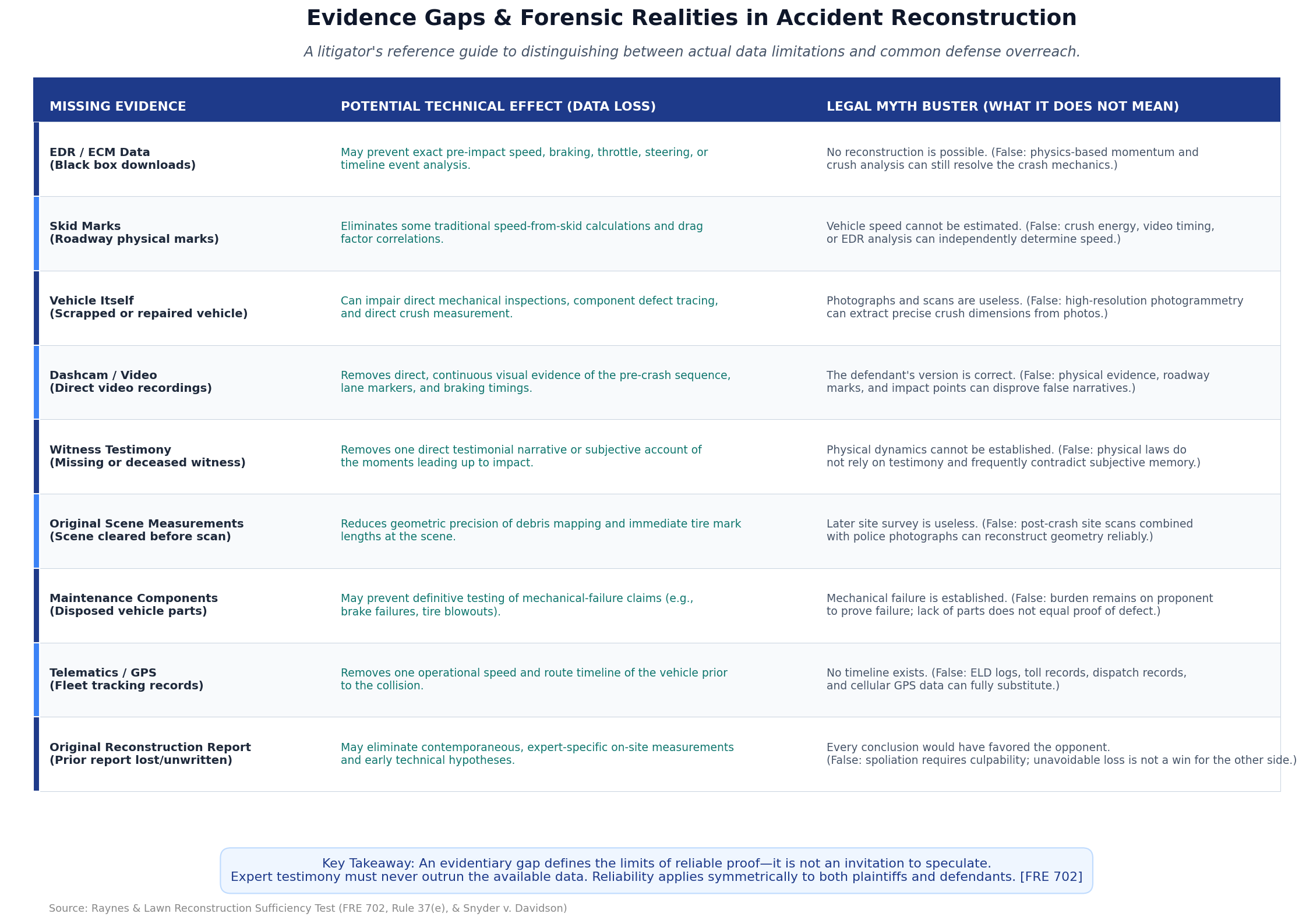
For any specific missing item, the useful question is which precise reconstruction question its absence prevents answering, not simply whether the reconstruction can be labeled incomplete. Missing event data recorder information may prevent an exact pre-impact speed calculation without necessarily preventing reliable conclusions about point of impact, travel direction, or post-impact movement. The absence of skid marks eliminates one traditional method of speed estimation without eliminating crush analysis, video analysis, or momentum analysis where those methods are otherwise supportable. Event data and other electronic systems can sometimes compensate for the absence of physical scene evidence, and the reverse is equally true; the materiality of any single missing item has to be evaluated against the specific conclusion it is being used to challenge.
When the Defendant Controlled the Missing Evidence, the Analysis Changes
The analysis shifts once the missing evidence was within a defendant’s control and should have been preserved. Federal Rule of Civil Procedure 37(e) applies to electronically stored information that should have been preserved in anticipation or conduct of litigation and was lost because reasonable steps were not taken; where prejudice results, a court may order proportionate curative measures, and more severe adverse-inference remedies require the specific findings the rule identifies, including an intent to deprive. New Jersey appellate authority has recognized an adverse inference where a carrier’s own data was allowed to disappear despite a preservation duty arising from anticipated litigation, consistent with the same institutional-response analysis relevant to how carriers handle post-crash data generally. Pennsylvania evaluates spoliation by weighing the degree of fault, the resulting prejudice, and whether a lesser sanction can correct the imbalance. Delaware requires a genuinely culpable mental state before an adverse inference is appropriate; an unexplained absence, standing alone, is not sufficient. A defendant may legitimately benefit from ordinary evidentiary uncertainty. It should not receive that same benefit where its own failure to preserve evidence, once a duty existed, is what created the uncertainty in the first place.
Spoliation Does Not Automatically Establish Negligence or Causation
Even a properly granted adverse inference does not typically convert every disputed issue into established liability. The purpose of a spoliation remedy is generally to correct an evidentiary imbalance caused by the loss, not to award substantive proof the missing evidence might never have actually established. A documented pattern of the same carrier’s data-handling failures across multiple incidents can support a broader systemic-negligence theory, but that is a distinct showing from the spoliation inference itself, and a case theory should not assume that a lost data file, by itself, proves the underlying claim.
Qualification and Disqualification Criteria
A matter involving a disputed or incomplete accident reconstruction may warrant disciplined review where the available record supports the following:
- A catastrophic injury or death where reconstruction evidence is central to establishing or refuting a specific, identifiable causation question.
- A clear account of which particular conclusion is affected by the missing evidence, rather than a generalized claim that the reconstruction is incomplete.
- Evidence sufficient to distinguish an ordinary, unavoidable evidentiary gap from a gap created by a party’s own failure to preserve evidence after a duty had arisen.
- An expert methodology, on the side advancing the claim, that matches its stated conclusions to the resolution the surviving evidence can actually support.
- A basis for anticipating and addressing the specific reliability challenges, such as frame-rate assumptions, stiffness-coefficient mismatches, or unsupported perception-reaction-time defaults, that could be raised against the reconstruction relied upon.
A matter does not ordinarily warrant advancement where the available evidence, even if incomplete, is sufficient to support the required conclusions by a preponderance, where the claimed gap does not actually affect the disputed issue, or where the theory of incompleteness rests on speculation about what missing evidence would have shown rather than on a reasoned account of it.
Litigation Readiness
Defense positions in this category of case commonly include the argument that the available evidence is sufficient for a reliable reconstruction despite the gaps, that any missing evidence resulted from the collision itself rather than from any failure to preserve it, or that the opposing expert’s conclusions exceed what the surviving data can support. A responsible evaluation anticipates each of these positions and, critically, applies the same reliability scrutiny to its own expert’s methodology before relying on it, since a Daubert-type challenge is available to either side and typically succeeds or fails on methodology, not on which party is more sympathetic.
Scope and Responsibility
The question raised by an incomplete accident reconstruction is not whether every conceivable evidence source was preserved. It is whether the evidence that survives permits the material disputed facts to be established, or refuted, with legally and scientifically sufficient reliability, and whether any gap in that evidence resulted from unavoidable circumstances or from a preventable failure to preserve what a party controlled. This inquiry sits within the firm’s broader work on catastrophic transportation litigation and catastrophic injury litigation generally, and it frequently requires independent expert review before the impact of any evidentiary gap on case viability can be responsibly assessed.
Referral and Case Review Inquiries
Raynes & Lawn evaluates a limited number of matters involving serious injury, institutional failure, and legally supportable theories of liability. Reviews are conducted to determine whether the medical, technical, and legal foundations required for responsible litigation are present.
Submissions may be made by individuals, families, or referring counsel. Any review is a threshold evaluation only and does not constitute acceptance of representation.
Request a Case Review