
Proving Conscious Pain and Suffering When Death Occurs Shortly After a Catastrophic Injury

When catastrophic injury is followed by death within seconds or minutes, the estate’s claim for conscious pain and suffering cannot rest on the severity of the trauma or on the fact that biological life continued for some measurable interval. The law compensates conscious experience, not survival time. The evidentiary task is to reconstruct whether meaningful awareness persisted after the injury, how long it persisted, and what the record actually permits a factfinder to conclude the person experienced, as distinct from what a family understandably believes must have been true.
Survival Damages and Wrongful-Death Damages Are Different Claims
A survival action and a wrongful-death action answer different questions, and the article, like the case, has to keep them separate. The survival action preserves a claim that belonged to the injured person before death; it does not compensate the family’s own loss. Pennsylvania’s survival statute, 42 Pa.C.S. § 8302, allows a decedent’s causes of action to survive, distinct from the state’s separate wrongful-death provision. New Jersey’s N.J.S.A. 2A:15-3 permits the decedent’s representative to recover damages that accrued during the decedent’s lifetime. Delaware’s survival statute, 10 Del. C. § 3701, preserves the decedent’s personal cause of action through the estate. When an estate proves conscious pain and suffering, it is pursuing the injured person’s own claim for the interval between injury and death, not the family’s grief.
Biological Survival Is Not the Same as Conscious Survival
This is the central conceptual distinction the entire doctrine turns on. Pennsylvania does not permit pain-and-suffering damages where the decedent remained unconscious throughout the interval between injury and death; in Nye v. Commonwealth Department of Transportation, the court held that survival damages for pain and suffering are unwarranted absent evidence of consciousness after impact. Delaware has described the requirement as “life plus”: evidence that a person remained alive for some period, even days, is insufficient unless the estate separately establishes that the person was sufficiently conscious to experience pain. New Jersey applies the same underlying principle, permitting pain-and-suffering damages only for suffering that was consciously experienced. The relevant interval is not measured from injury to biological death. It is measured from injury to the loss of meaningful awareness, and those two endpoints are not the same thing.
The Required Interval Is Not Described Identically Across These Three States
New Jersey is comparatively explicit that conscious survival can be very brief. In Tirrell v. Navistar International, a decedent was dragged and eventually crushed by a slowly rolling tractor-trailer; although death followed quickly, testimony that he raised his head before dying was enough for the jury to infer a brief but distinct period of physical pain and anticipation of death. The New Jersey Supreme Court later summarized the principle in Smith v. Whitaker: pain-and-suffering recovery may be available when the injured person survives the injury however briefly, provided consciousness is actually supported by evidence. Pennsylvania requires post-injury consciousness but imposes no universal minimum duration; fact testimony describing a decedent’s responsiveness and visible distress before losing consciousness has been sufficient on its own. Delaware uses the formulation “some appreciable interval” and expressly rejects recovery where suffering was merely contemporaneous with death, but it does not impose a mechanical stopwatch rule either; in Midcap v. Sears, expert testimony that the decedent may have remained conscious for roughly fifteen to thirty seconds after an explosion was allowed to reach the jury. There is no defensible claim that any fixed number of seconds is categorically sufficient or insufficient across these jurisdictions.
Purposeful Behavior Can Matter More Than the Clock
Direct evidence of consciousness includes speech, attempts to answer, command-following, eye contact, purposeful limb movement, and vocalization accompanied by responsive behavior. In Pennsylvania’s Slaseman v. Myers, witnesses including a registered nurse testified that the decedent looked toward those assisting him and appeared conscious and in pain. In New Jersey’s Estate of Kotsovska, witnesses described open eyes, labored breathing, groaning, and apparent attempts to respond for several minutes after a traumatic amputation, and the Appellate Division held that was ample evidence from which conscious suffering could be found. But movement alone is not synonymous with awareness, and Tirrell illustrates the dispute directly: the defense argued the observed head movement could have been a post-death spasm rather than a conscious response. A rigorous record has to separate what a witness actually observed from what the witness concluded that observation meant.
Eyewitness Testimony Can Be Enough Without an Expert
The article, and a case theory, should not overstate the necessity of forensic testimony. Pennsylvania’s Estate of Cowher v. Kodali is a useful illustration: a neighbor observed the decedent remain conscious for approximately three minutes, ask for help, breathe heavily, and appear distressed before collapsing, and Pennsylvania appellate authority found that fact testimony alone sufficient to establish a brief period of conscious pain and distress. New Jersey cases similarly rely on eyewitness observations of purposeful movement, open eyes, breathing, and attempted communication. Expert testimony explains whether an injury mechanism was medically consistent with consciousness; fact witnesses establish what the person actually did. The strongest record contains both, but the absence of an expert does not automatically defeat a claim where credible lay observation exists.
Forensic Pathology Can Reconstruct a Consciousness Window Where No One Witnessed It
Where there is no clear eyewitness account, medical experts can become central, analyzing the injury mechanism, brain and brainstem involvement, cervical spinal injury, cerebral blood flow, airway status, and the expected physiological path to loss of consciousness. In Wilkoski v. B&T Express, a federal Pennsylvania truck-crash matter, a forensic pathologist opined that the decedent experienced roughly ten to fifteen seconds of conscious pain and suffering based on high cervical injury, diaphragmatic paralysis, and interruption of blood supply to the brain. Delaware’s Midcap involved comparable forensic testimony, where residual cerebral oxygen and the absence of immediate devastating brain trauma supported an estimated consciousness interval of roughly fifteen to thirty seconds. An opinion of this kind has to trace a specific mechanism, from the actual injuries to the physiological path to loss of consciousness to the interval that mechanism supports; a generic statement that people with a given injury usually remain conscious briefly is not the same thing.
Expert Opinions on Consciousness Face the Same Reliability Scrutiny as Any Other Causation Testimony
The brevity of the claimed interval does not reduce an expert’s methodological burden; it increases it, because when the conclusion concerns only a few seconds, assumptions about cerebral perfusion, respiratory failure, and injury sequence can determine the entire damages theory. Delaware’s more recent authority has scrutinized this closely: in Truitt v. Winder (2025), the court emphasized that expert evidence can be important to establishing consciousness while examining whether the testimony reliably established actual awareness rather than merely biological survival, and Andino v. Nexius Solutions (2026) addressed expert qualifications and methodology on this same question. A consciousness opinion has to be built the same way any other causation opinion is: from specific facts and a stated, testable methodology, not from intuition about what people in similar situations usually experience.
Glasgow Coma Scores Are Evidence, Not an Automatic Answer
EMS and hospital records document neurological status, responsiveness, command-following, spontaneous movement, and painful-stimulus response, and the Glasgow Coma Scale is a familiar, quantified measure of that status. But a single overall score should not be treated as a binary answer. A low overall score can reflect an inability to speak or open the eyes because of a crushed chest, facial trauma, or intubation, while a comparatively higher motor component, active withdrawal from a painful stimulus, for example, can still reflect the kind of higher cortical function relevant to conscious suffering. The full chronology matters more than any single number: the interval between the injury, the first witness observation, EMS arrival, the first neurological assessment, and any airway management or medication given before that assessment. A score recorded several minutes after impact does not necessarily describe the patient’s condition in the first moments, and New Jersey’s Stemple line of authority reflects that a later finding of deep coma does not eliminate earlier eyewitness evidence of awareness.

Figure: Glasgow Coma Scale clinical zones and how each is typically treated at trial.
Fear and Apprehension of Death Require Separate Jurisdictional Analysis
This is a point where a generalized statement is actively misleading. Pennsylvania’s Nye expressly rejected survival damages for pre-impact fright; the state’s survival measure is limited to pain, suffering, and distress occurring after the injury, and an article should never suggest Pennsylvania allows recovery merely because someone saw a collision approaching. New Jersey recognizes apprehension of impending death within survival damages where consciousness is otherwise supported, and Tirrell permitted the jury to infer a brief period of anticipation as the decedent was dragged. Delaware recognizes conscious fear, fright, and terror before death where the required post-injury consciousness is independently established. These are three different rules, not one rule stated three ways.
Extreme Injury Does Not Establish Extreme Conscious Suffering, and Inability to Speak Does Not Establish Unconsciousness
A person can sustain traumatic amputation, catastrophic cranial or thoracic injury, or extensive burns and still lose consciousness essentially immediately; the severity of the physical injury cannot substitute for proof of awareness. New Jersey’s Kotsovska is instructive because a trial court initially suggested that a conscious person sustaining traumatic amputation necessarily experiences pain, and the Appellate Division held that consciousness is not a matter for judicial notice; the award was upheld only because independent witnesses actually supplied evidence of awareness. The inverse caution matters equally: an inability to speak, from airway injury, intubation, paralysis, or facial trauma, does not itself establish unconsciousness, and relevant nonverbal evidence can include purposeful eye movement, command-following, or a directed physical response, evaluated carefully rather than assumed.
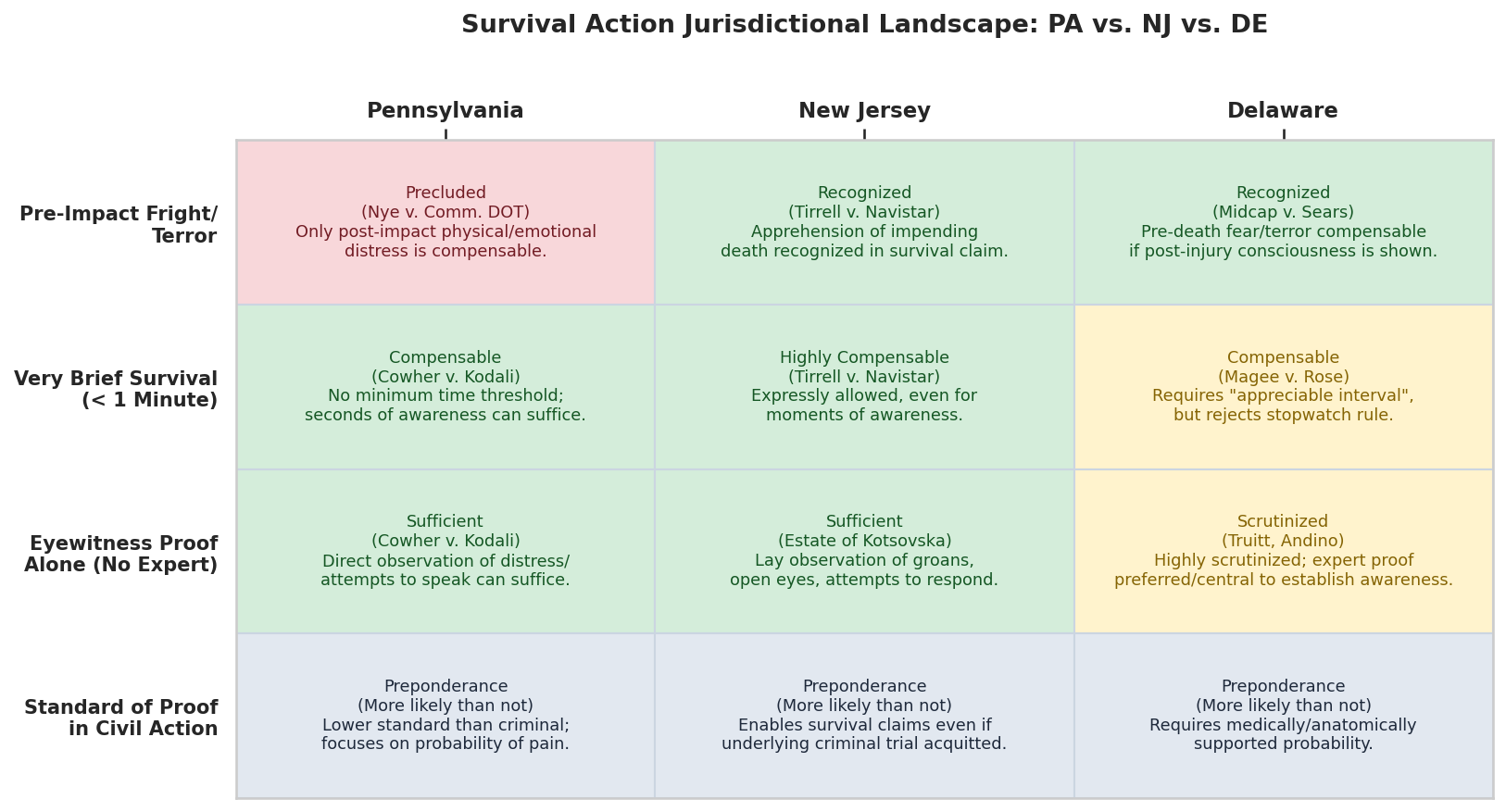
Figure: Pennsylvania, New Jersey, and Delaware compared across the consciousness, pre-impact fright, and proof-sufficiency questions discussed above.
The Defense Will Attack Whether Observed Behavior Was Purposeful or Reflexive
This is the central factual dispute in most short-survival cases. Potential alternative explanations for observed activity include spinal reflex, agonal respiratory movement, seizure activity, and terminal posturing, and Tirrell itself shows how directly this gets litigated, with the defense characterizing an observed head movement as spasmodic rather than conscious. A frequently cited illustration from outside this practice’s core jurisdictions, a New York case in which a forensic pathologist estimated eight to ten seconds of consciousness split between pre-impact terror and post-impact awareness, turned on precisely this dispute: the defense’s own expert characterized the decedent’s hand squeeze as reflexive, and the jury was entitled to credit the plaintiff’s expert instead. That case is useful only as an illustration of how the dispute is actually litigated; it is New York authority, not Pennsylvania, New Jersey, or Delaware law, and should never be cited as though it controlled the standard in any of the three states this practice covers.
Qualification and Disqualification Criteria
A matter involving conscious pain and suffering following a rapid death may warrant disciplined review where the available record supports the following:
- Objective or credible eyewitness evidence of consciousness after the injury, rather than an inference drawn solely from the severity of the trauma or the duration of biological survival.
- A reconstructable chronology connecting the injury, the earliest reliable observation, EMS assessment, and any treatment that could independently explain a later inability to respond.
- A basis for distinguishing purposeful behavior from reflexive, agonal, or medication-related activity, supported by either direct testimony or expert physiological analysis.
- Where expert reconstruction is required, a methodology that traces specific injuries to a physiological mechanism and a supportable time interval, not a general statement about typical outcomes for similar injuries.
- A jurisdiction-specific framework for both the consciousness requirement and any claim of pre-death fear, since Pennsylvania, New Jersey, and Delaware apply meaningfully different rules, particularly regarding pre-impact fright.
A matter does not ordinarily warrant advancement where the record establishes only biological survival without any evidence of awareness, where the claimed interval rests on unsupported assumption rather than a documented or medically reasoned basis, or where the injury mechanism itself is inconsistent with any period of preserved consciousness.
Litigation Readiness
Defense positions in this category of case commonly include the argument that death or loss of consciousness was effectively instantaneous, that observed movement or vocalization was reflexive or agonal rather than volitional, that a low Glasgow Coma Scale score at first assessment establishes unconsciousness, or that an expert’s estimated consciousness interval is speculative rather than grounded in the specific injury mechanism. A responsible evaluation anticipates each of these positions and builds the chronology, and any expert opinion relied upon, with enough precision to withstand exactly this kind of challenge, since the shorter the claimed interval, the more exacting the scrutiny it will receive.
Scope and Responsibility
The question a short-interval survival case raises is not whether the underlying injury was catastrophic. It is whether the available evidence supports a period of actual conscious awareness after that injury, how long that period lasted, and what the decedent can be shown to have experienced during it, without asking the factfinder to infer consciousness from injury severity alone. This inquiry sits within the firm’s broader work on wrongful death litigation and catastrophic injury litigation generally, and it frequently requires coordinated forensic pathology and emergency medicine review of the complete pre-hospital and hospital record before a defensible damages theory can be constructed.
Referral and Case Review Inquiries
Raynes & Lawn evaluates a limited number of matters involving serious injury, institutional failure, and legally supportable theories of liability. Reviews are conducted to determine whether the medical, technical, and legal foundations required for responsible litigation are present.
Submissions may be made by individuals, families, or referring counsel. Any review is a threshold evaluation only and does not constitute acceptance of representation.