
Delayed Transfer to a Level 1 Trauma Center: When Timing Becomes the Central Causation Question
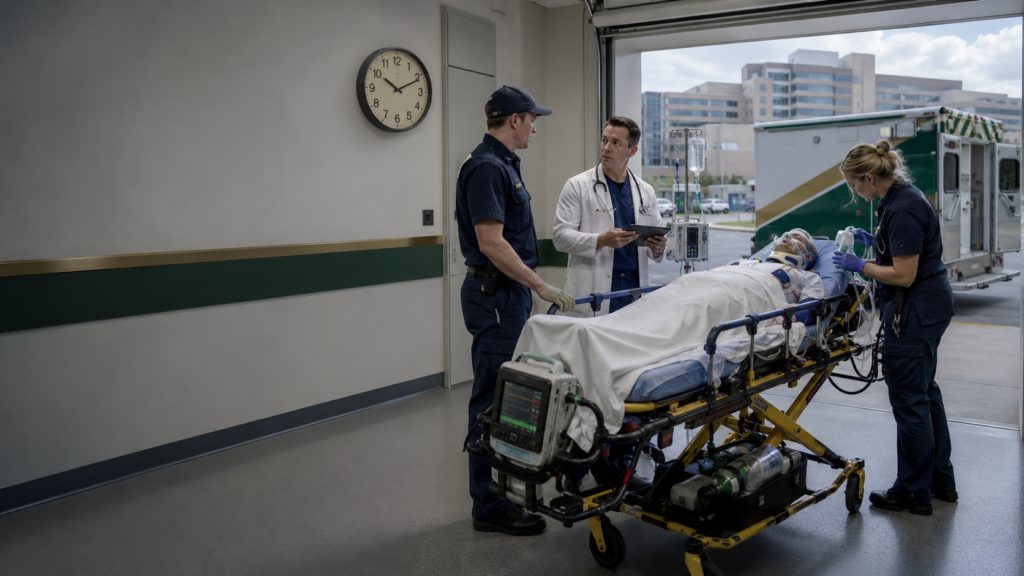
A delayed transfer to a higher-level trauma center does not become a viable litigation theory by the mere passage of time. The case must do considerably more: it must identify when the patient’s needs exceeded the sending facility’s capabilities, establish which portion of the resulting interval was avoidable, trace what happened physiologically during that interval, and demonstrate that earlier access to a specific intervention would probably have changed a specific outcome under the governing causation standard. Trauma-center designation, elapsed transfer time, and population-level mortality studies each provide useful context, but none independently establishes causation in an individual case.
The Article Title Requires One Precision Adjustment
The better working title is “Delayed Transfer to a Higher-Level Trauma Center” rather than “Level I Trauma Center” specifically. The distinction is substantive. Under current American College of Surgeons standards, Level II centers provide definitive care for a broad range of serious injuries; Level I status adds depth of resources, research infrastructure, and system leadership, but does not automatically mean that every severely injured patient requires Level I specifically. A study of more than fourteen thousand transferred patients with isolated traumatic brain injury found no adjusted mortality difference between Level I and Level II receiving centers. The transfer question is resource-specific. The theory must identify which capability the patient required and whether that capability was unavailable where the patient was, not simply that a higher-level center existed nearby.
A Transfer Delay Case Begins With Capability, Not the Clock
The first question in any delayed-transfer case should be: what did the patient need that the sending hospital could not provide? ACS currently describes Level I centers as capable of comprehensive trauma care for all injuries with deep personnel and institutional resources, Level II centers as capable of initial definitive care across a broad range of injury severity, and Level III centers as providing care for mild-to-moderate injury while maintaining processes for prompt evaluation, initial management, and transfer when patient needs exceed available resources. Pennsylvania’s system mirrors that structure: Level III centers stabilize and transport severely injured patients while Level IV centers provide initial stabilization and arrange transfer. Delaware’s Level III centers stabilize and triage while arranging timely transfer where additional regional or specialty resources are required.
A theory built on “the patient should have been at a Level I center” is too imprecise and too easy to attack. A theory built on “the patient’s documented vascular injury required immediate operative control that the sending hospital could not provide, which remained unavailable for an additional three hours” is specific, testable, and considerably more defensible.
Transfer Standards Provide Context but Do Not Prove Medical Negligence
The 2022 ACS Resources for Optimal Care of the Injured Patient states that transfer decisions should be based on the injured patient’s needs rather than insurance or payer considerations, and ACS trauma-system guidance emphasizes matching patient condition to receiving-facility resources. CMS separately requires participating emergency departments confronting an emergency medical condition to provide stabilizing care within their capabilities or, where necessary, an appropriate transfer. The EMTALA analysis asks whether stabilizing treatment within the hospital’s capability was provided and whether any transfer was appropriate — but an EMTALA violation and a state-law negligence claim are distinct inquiries, and statutory compliance with one does not automatically resolve the other. More importantly, neither trauma-system guidance nor federal stabilization requirements independently establishes that a delay caused a particular patient’s catastrophic harm. That requires separate causation proof.
The Relevant Delay Is Not Simply “Time From Arrival to Transfer”
A rigorous analysis breaks the transfer into components rather than treating the entire interval as one undifferentiated delay. The sequence runs from arrival at the first hospital through initial resuscitation, first recognition of major injury, first reasonable recognition that local capability was insufficient, specialist consultation, decision to transfer, receiving facility contact and acceptance, transport request, patient preparation for transport, departure, and arrival at the receiving trauma center through to definitive intervention. The legally significant question is not how long the patient was at Hospital A. It is which portion of that interval represented necessary evaluation and stabilization, and which portion represented avoidable delay after the need for higher-level care became reasonably apparent. That distinction is what makes the causation theory resistant to impeachment.
Some Evaluation Before Transfer Is Necessary; Some Can Become a Source of Delay
The article should not take the simplistic position that all pre-transfer testing constitutes delay. Patients may genuinely require stabilization, blood products, airway control, or chest decompression before safe transport. But the literature demonstrates that duplicative or nonessential imaging can materially extend referring-hospital dwell time. One study found that transferred trauma patients undergoing CT at the sending hospital remained there approximately ninety minutes longer on average than patients not undergoing pre-transfer CT. A separate physician survey found that 33.1% of respondents reported obtaining imaging because they believed the receiving center expected it, while 28% cited liability concerns as a reason to image even where transfer was delayed, and 45% cited either perceived requirements or liability concerns. More recent RTTDC data showed that training emphasizing early recognition and expedited transfer reduced referring-facility dwell time by about sixty-four minutes and transfer-decision time by about sixty-two minutes, while reducing pre-transfer imaging — and, critically, mortality did not change in that particular observational program.
That last finding is the most important one for causation purposes. Evidence that a process caused delay is not the same as evidence that the delay caused the patient’s injury.
Trauma Transfer Is a Period of Clinical Risk, Not Merely Transportation
A 2024 study based on the Pennsylvania Trauma Outcomes Study provides unusually relevant regional evidence for this practice’s primary jurisdiction. Among 52,919 patients who were hemodynamically stable when first evaluated and then transferred to a Pennsylvania trauma center, 5,331 — approximately 10.1% — arrived at the receiving center with hemodynamic deterioration. Those patients were more likely to require ICU admission, immediate surgery, or interventional radiology, and mortality was 4.9% compared with 2.1% among patients who remained stable. That is strong evidence that the transfer interval can coincide with meaningful physiological deterioration. But it should not be converted into “transfer delay doubled mortality.” The study was observational and investigated deterioration occurring across the transfer process; it does not establish that negligent delay caused every deterioration, or that an earlier transfer would have prevented any particular patient’s deterioration. A changing physiological record during transfer may be more probative than elapsed minutes alone.
Time Sensitivity Is Injury-Specific
There is no scientifically responsible universal trauma stopwatch, and the article should say so plainly. In active hemorrhage, older registry data found mortality increased with emergency-department time during the first ninety minutes, with a rough estimate of approximately one percent increased mortality per three minutes of delay in the selected study population with intra-abdominal bleeding requiring laparotomy. A separate retrospective study of hypotensive torso gunshot wounds reported significantly increased mortality when operative intervention began more than ten minutes after arrival. But a multicenter prospective study of noncompressible torso hemorrhage produced the opposite interpretive problem: non-survivors actually reached hemorrhage-control surgery faster, because they were more physiologically devastated. The authors concluded that even expedited care may be too late in some patients with profound bleeding. That result illustrates why faster treatment correlating with worse outcomes can reflect injury severity rather than harmful speed — the same confounding that operates in both directions when plaintiffs rely on observational associations between longer delays and worse outcomes.
In severe traumatic brain injury, one retrospective comparison reported mortality of 19.3% in directly transported patients versus 35.8% in secondary transfers, with secondary-transfer patients reaching trauma centers much later. The authors recommended direct transport to Level I or II centers where serious TBI is suspected unless lifesaving stabilization is first required elsewhere. But once transfer to higher-level care occurred, another large study found no adjusted mortality difference between Level I and Level II centers for isolated TBI — reinforcing the point that “Level I specifically” is often not the meaningful treatment variable. A 2024 nationwide TBI study also found that roughly one-third of transferred isolated intracranial-hemorrhage patients were discharged within forty-eight hours without neurosurgical intervention, emphasizing the need to avoid assuming that every intracranial injury necessarily requires transfer to the highest-level center.
The “Golden Hour” Should Not Become the Legal Causation Standard
The phrase is familiar, but scientifically too blunt for litigation. A North American prospective cohort of 3,656 injured patients with prehospital physiologic abnormalities found no statistically significant association between mortality and the various EMS time intervals studied. A systematic review subsequently found that the influence of time varied according to injury pattern, with faster transport appearing particularly beneficial in traumatic brain injury and hemodynamically unstable penetrating trauma, while broad undifferentiated trauma populations did not support a simple universal time relationship. The better formulation is that trauma is time-sensitive, but the clinically important interval depends on the injury, physiological state, treatment required, and the sending facility’s ability to provide meaningful stabilization. Any expert opinion anchored to a universal sixty-minute rule is vulnerable to exactly this literature.
Trauma-Center Outcome Studies Establish System Value, Not Individual Causation
One of the foundational national studies comparing Level I trauma centers with non-trauma hospitals found, after adjustment, lower in-hospital mortality — 7.6% versus 9.5% — and lower one-year mortality — 10.4% versus 13.8% — with the apparent benefit concentrated mainly among patients with more severe injuries. That supports regionalized trauma care as a system design. It does not establish that had this particular patient arrived at a Level I center ninety minutes earlier, this death or neurological injury would have been avoided. System-level effectiveness must not be substituted for case-specific counterfactual causation.

Causation Requires Identifying the Intervention the Patient Reached Too Late
This is the analytical core of any valid delayed-transfer theory. A weak case says the patient should have been transferred sooner. A stronger case traces a specific sequence: by a specific time, the patient’s findings required a capability unavailable at the sending hospital; transfer reasonably could have placed the patient at a receiving center at a reconstructed earlier time; the definitive procedure could then have occurred while neurological, vascular, or hemodynamic function remained salvageable; instead, the procedure began later after documented deterioration; and qualified expert evidence supports that the delay materially changed the outcome. The exact intervention may be operative hemorrhage control, neurosurgical decompression, endovascular treatment, vascular repair, thoracic surgery, complex pelvic hemorrhage intervention, or another subspecialty service unavailable at the sending institution. The causal chain should trace through recognizable injury to sending-facility resource limit to transfer indicated to avoidable delay to progressive pathophysiology during delay to definitive intervention reached later to lost salvageable function.
Pennsylvania Provides a Strong Institutional-Negligence Framework
Pennsylvania recognizes direct corporate liability of hospitals under Thompson v. Nason Hospital, 591 A.2d 703 (Pa. 1991), which described the hospital’s nondelegable responsibilities to maintain adequate facilities and equipment, select and retain competent physicians, oversee practitioners as to patient care, and formulate, adopt, and enforce adequate policies designed to ensure quality care. The hospital must have actual or constructive knowledge of the problem, and institutional negligence must be a substantial factor in causing harm. That framework is directly applicable to delayed-transfer cases where the issue is not simply one physician’s judgment but whether the institution had appropriate escalation policies, specialist-availability mechanisms, transfer criteria, transfer-center procedures, communication protocols, and transport escalation procedures. A transfer case can therefore shift from “Doctor A waited too long” to “what system was supposed to recognize and escalate a patient whose needs exceeded the facility’s resources?” — which is precisely the inquiry this firm’s institutional-systems doctrine is built to pursue.
Increased-Risk Doctrine May Govern When the Trauma Itself Already Threatened the Outcome
Transfer-delay cases are causation-difficult because the patient is already seriously injured before any alleged negligence begins. The defense argument is obvious: the crash, fall, gunshot wound, or original trauma — not the delay — caused the catastrophic outcome. Pennsylvania’s Hamil v. Bashline permits a factfinder, in appropriate increased-risk cases, to determine whether negligent conduct that increased the risk of the harm that ultimately occurred was a substantial factor in producing it. New Jersey’s Scafidi v. Seiler applies a comparable increased-risk and substantial-factor framework where negligence combines with a preexisting condition capable of independently causing the ultimate harm, with an additional requirement that damages reflect the value of the lost chance attributable to the negligence rather than charging the defendant with the entire outcome. Delaware’s Anderson recognizes reduced survival opportunity as a potentially compensable injury distinct from death itself, but Kardos demonstrates the evidentiary limit: the expert still must establish with reasonable medical probability that the negligence caused an actual reduction in the individual’s chance, not simply point to population statistics. These three doctrines are not interchangeable.
Qualification and Disqualification Criteria
A delayed-transfer matter may warrant disciplined review where the available record supports the following:
- A catastrophic injury, permanent neurological impairment, loss of vital bodily function, limb loss, lifelong care needs, or wrongful death.
- An injury pattern indicating a need for time-sensitive higher-level trauma resources, with identification of the specific resource or capability that was unavailable at the sending facility.
- Objective evidence that the sending facility lacked the required capability or could not provide definitive care in the necessary time, as distinct from a general preference for a higher-designation center.
- A reconstructable chronology that separates necessary stabilization from avoidable delay and identifies the point at which transfer reasonably should have been initiated.
- Expert support establishing that earlier arrival and intervention would likely have changed the outcome — not simply that arriving earlier is generally preferable.
- Evidence of a policy, staffing, communication, triage, transport escalation, or institutional-systems failure sufficient to support a corporate-negligence theory alongside any individual physician claim.
- A record capable of surviving defense arguments about injury irreversibility, medical judgment, alternative causation, and transport limitations.
A matter does not ordinarily warrant advancement where the theory rests on elapsed time alone without a specific unavailable capability, where the patient’s catastrophic condition was already irreversible before transfer reasonably could have changed the course, or where the claimed harm is separable from the original injury only by speculation about what earlier treatment might have accomplished.
Litigation Readiness
Defense positions in this category of case commonly include the argument that the injury was non-survivable or irreversible before presentation, that the receiving center would not have provided a different intervention, that stabilization at the sending facility was necessary and appropriately consumed the disputed interval, that transfer was requested and executed as promptly as conditions permitted, or that physiological deterioration resulted from the initial traumatic mechanism rather than any avoidable delay. A responsible evaluation anticipates each of these positions and builds the case around the counterfactual timeline — not around the proposition that trauma care is generally time-sensitive, but around the specific question of what this patient’s record shows was still salvageable, and what qualified evidence establishes that earlier treatment would have reached it.
Scope and Responsibility
The question a delayed-transfer case raises is not whether the patient spent longer at the sending hospital than ideal. It is whether a definable period of avoidable delay withheld a specific intervention from a patient whose records and qualified experts show that the withholding materially changed a catastrophic outcome. This inquiry sits within the firm’s broader work on catastrophic injury litigation, medical negligence litigation, and institutional negligence and systems failure litigation, and it frequently requires coordinated trauma surgery, emergency medicine, neurosurgical, vascular, and institutional-systems expert review before a defensible causation and damages theory can be constructed.
Referral and Case Review Inquiries
Raynes & Lawn evaluates a limited number of matters involving serious injury, institutional failure, and legally supportable theories of liability. Reviews are conducted to determine whether the medical, technical, and legal foundations required for responsible litigation are present.
Submissions may be made by individuals, families, or referring counsel. Any review is a threshold evaluation only and does not constitute acceptance of representation.