
Disputing Causation in Cases Involving Lithium-Ion Battery Failure and Catastrophic Burns
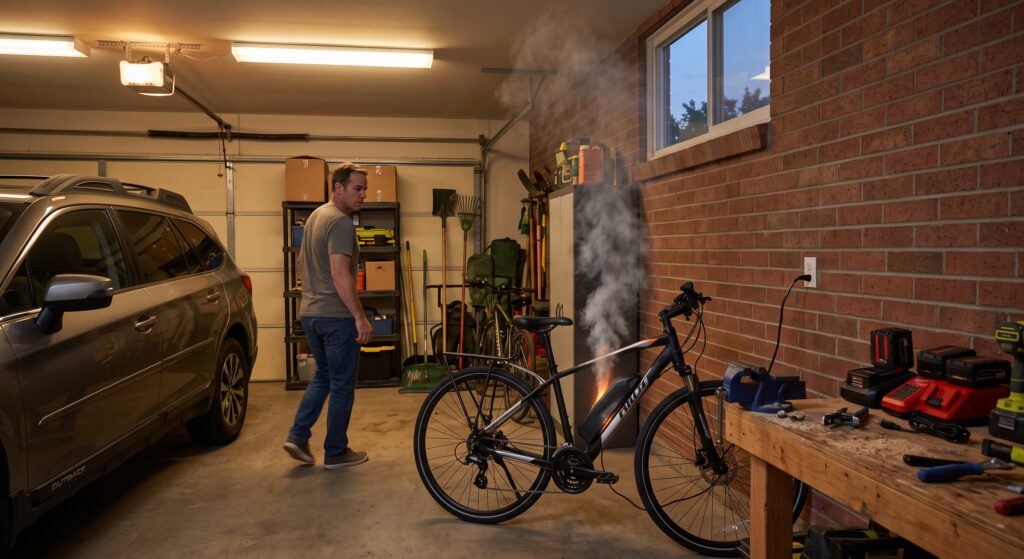
A lithium-ion battery fire is, in a narrow but important sense, self-erasing. When a cell enters thermal runaway, the resulting heat and combustion frequently destroy the physical evidence that would show why the failure began. A cell that initiated a fire through an internal defect and a cell that was simply caught in a fire that started somewhere else can look nearly identical afterward. That evidentiary reality, more than any question about whether battery fires are dangerous, is the central problem a catastrophic burn case involving a lithium-ion battery has to solve.
Thermal Runaway Is a Process, Not an Explanation
Thermal runaway describes a self-accelerating chain reaction inside a battery cell, in which internal heat generation outpaces the cell’s ability to dissipate it. The literature describes this unfolding in stages: breakdown of the protective layer coating the electrode at moderate temperatures, decomposition of the electrolyte that releases flammable gas as the cell heats further, melting of the separator that keeps the electrodes apart, which can itself trigger an internal short circuit, and finally decomposition of the cathode material, which releases additional gas and oxygen and intensifies the reaction. Once fully underway, a single cell’s temperature can climb rapidly within minutes, and the reaction can propagate from one cell to its neighbors within a battery pack.
That description matters for litigation because it establishes vocabulary, not causation. Evidence that a cell underwent thermal runaway does not, by itself, establish what triggered it. Recognized categories of trigger include thermal exposure from an external heat source or fire, mechanical damage such as a drop, crush, or puncture, electrical abnormalities including a short circuit, overcharging, or use of an incompatible charger, and manufacturing or aging-related defects such as separator degradation or contamination introduced during production. Each category points toward a different party and a different theory of the case, and a causation opinion that stops at “the battery underwent thermal runaway” has not yet answered the question that matters.
Why the Evidence Record Often Cannot Answer the Question
Fire investigators describe a genuine forensic dilemma with lithium-ion batteries recovered from a fire scene: post-fire damage frequently cannot show whether the battery caused the fire or whether the battery failed because it was exposed to a fire that started elsewhere. Individual cells can also be ejected several feet from the rest of a failed pack during venting, which can create the misleading appearance of multiple points of origin and complicate the physical reconstruction of the scene.
NFPA 921, the widely used guide for fire and explosion investigation, provides the governing methodology for working through that dilemma. It requires an investigator to document the scene, identify the area of origin, test competing hypotheses rather than settling on the first plausible one, and avoid stating a conclusion broader than the physical evidence actually supports. Applied to a battery-involved fire, that means an investigator has to determine whether the battery was the initiating event, a contributing factor, or simply another combustible item consumed by a fire that began elsewhere, and the mere presence of a charred battery in the debris does not answer that question on its own.
Because post-fire battery debris is so often ambiguous, evidence preservation becomes close to outcome-determinative. The physical battery, the charger, any surviving connectors or battery-management-system data, and the immediate scene around the device are the evidence a causation opinion will ultimately depend on. Where that material is discarded, damaged further during cleanup, or not promptly secured, a causation opinion may become difficult or impossible to support responsibly, regardless of what actually happened.
General Causation Is Not Specific Causation
One distinction does more work in this category of litigation than any other: the difference between evidence that lithium-ion batteries can cause fires and evidence that this particular battery caused this particular fire. Establishing the first does not establish the second, and the difference between general and case-specific causation is frequently where a well-supported theory of liability either holds together or comes apart.
Federal courts applying Rule 702 and Daubert have addressed this exact problem in the lithium-ion battery context. In Gopalratnam v. Hewlett-Packard Co., 877 F.3d 771 (7th Cir. 2017), a case arising from a fatal house fire attributed to a laptop battery cell, the district court excluded the plaintiffs’ causation experts, and the Seventh Circuit affirmed. The court found that the underlying premise connecting the physical condition of the recovered cell to an internal defect was not adequately supported by reliable, tested methodology, and that the experts had not sufficiently accounted for alternative explanations for what the physical evidence showed. In a more recent case, American Home Assurance Co. v. Makita Corp. of America, a federal court in the Northern District of Indiana reviewing expert testimony in a battery-fire subrogation dispute allowed a fire-origin investigator to testify about the area of origin and the elimination of other ignition sources, where his method of ruling out alternatives was adequately explained, while restricting opinion testimony that moved beyond his demonstrated area of expertise into battery-specific failure analysis.
Neither decision should be read as a general rule binding outside the courts that decided them, and neither is a substitute for evaluating the specific record in a new case. What they illustrate is a recurring structural problem: an internal short circuit is a description of a physical failure mode, not an explanation of why it happened, and the step from “the cell shows evidence of an internal short” to “the short arose from a manufacturing defect” is a separate inferential step that requires its own support. A causation opinion that cannot explain what specific defect existed, where in the manufacturing or design process it originated, and why alternative explanations, including mechanical damage, charging conditions, or aging, have been ruled out, is vulnerable regardless of how experienced the expert is.
The Battery as a System
A rigorous causation analysis usually cannot stop at the cell. A modern lithium-ion battery product is a system: the individual cells, the pack architecture, the battery-management system responsible for monitoring voltage and temperature, the charger, and in some products the device firmware that governs charging behavior. A cell that is not itself defective can still fail catastrophically if the management system or charging system allows it to operate outside a safe range, and standards governing products such as e-bikes evaluate the battery, charger, and drive train together rather than treating the cell as an isolated component.
That systems view reframes the central causation question. It is not only whether a cell was defective, but whether the surrounding system, and the design and warning decisions behind it, permitted a cell, defective or not, to be pushed into conditions that produced the failure. Design-defect and failure-to-warn theories diverge in exactly this respect: a design-defect theory examines whether the battery-management architecture and thermal protection were adequate, while a failure-to-warn theory examines whether charging and storage risks, including the risk of an incompatible charger, were adequately communicated.
Standards Establish Expectations, Not Individual Causation
Products in this category are frequently governed by industry standards addressing the electrical systems of personal e-mobility devices, e-bikes, and light electric vehicle batteries, and federal regulators have moved toward more comprehensive mandatory standards for battery systems used in micromobility products. Those standards are useful evidence of expected safety performance, foreseeable misuse conditions, and industry practice. They are not, standing alone, proof of what happened in an individual case. A product’s compliance with an applicable standard does not establish that a subsequent fire was unrelated to the battery, and a fire does not by itself establish that a product failed to meet an applicable standard; how regulatory compliance interacts with a liability claim is a case-specific question, not a shortcut around the causation analysis.
Two Experts, Two Domains
Fire-origin investigation and battery-failure analysis are related but distinct disciplines, and conflating them is a recurring vulnerability in this category of case. A fire-origin investigator, trained in NFPA 921 methodology, can generally identify the area of origin, evaluate fire patterns and propagation, and rule out ignition sources unrelated to the battery. Determining why a specific cell failed, whether the failure mechanism is consistent with a manufacturing defect, a design inadequacy, or an externally caused condition, and whether the battery-management system functioned as intended, typically calls for a battery or electrochemical engineer with cell-specific expertise. A causation opinion that asks a fire investigator to reach a battery-specific defect conclusion without that expertise, or asks a battery engineer to reach conclusions about scene-level fire dynamics without that expertise, invites exactly the kind of challenge Rule 702 is designed to catch.
Catastrophic Burn Causation Has Its Own Chain
A battery-failure event can produce harm through more than one mechanism: direct flame exposure, a concentrated jet flame from venting gases that ignite, ejected hot material, blast-related trauma, and inhalation injury from toxic combustion products, sometimes compounded by a secondary structure fire. Burn-center literature describes lithium-ion battery events, particularly those involving larger packs such as e-bikes and micromobility devices, as capable of producing extensive burn injury requiring surgical treatment, but published case series describe a range of outcomes rather than a single predictable severity, and they should be read as evidence of possible severity rather than a population-level prediction for any individual event. Establishing that a battery failure caused catastrophic injury still requires connecting the specific exposure mechanism, whether flame, blast, or inhalation, to the injuries actually documented in the medical record, in the same evidentiary manner the rest of the causation chain requires.
Qualification and Disqualification Criteria
A matter involving a lithium-ion battery failure and burn injury may warrant disciplined review where the available record supports the following:
- A catastrophic burn injury, permanent disfigurement, functional impairment requiring surgical intervention, or a related wrongful death.
- Physical evidence, including the battery, charger, or scene material, sufficient to support a forensic origin-and-cause investigation, or a credible account of why that evidence is unavailable.
- A specific, evidence-supported failure theory, whether design defect, manufacturing defect, or failure to warn, rather than a generalized assertion that the battery failed.
- Expert capacity in both fire-origin investigation and battery or electrochemical engineering, applied within each expert’s actual area of demonstrated expertise.
- A causation analysis that addresses and rules out plausible alternative explanations, including mechanical damage, charging conditions, and use of incompatible components.
A matter does not ordinarily warrant advancement where the physical evidence was discarded or lost before it could be examined, where the theory rests on the general proposition that lithium-ion batteries can catch fire without case-specific proof, where only property damage occurred, or where the injury cannot be connected to a specific documented exposure mechanism.
Litigation Readiness
Defense positions in this category of claim commonly include the argument that the battery was a fuel source consumed by a fire of unrelated origin rather than its cause, that post-fire debris cannot reliably distinguish a pre-fire defect from fire-caused damage, that user misuse, an incompatible charger, or physical abuse caused or contributed to the failure, and that evidence lost during firefighting or scene cleanup undermines any origin-and-cause opinion that followed. Each of these positions can be tested against the physical evidence, the fire investigation record, and the chain of custody, but a case that cannot address them with a coherent, record-supported account, developed by experts working within their respective domains, is not positioned for disciplined litigation.
Scope and Responsibility
The question a lithium-ion battery burn case presents is not whether thermal runaway occurred. It is whether the available evidence supports a specific, provable failure mechanism connecting a product defect to that event and, in turn, to the catastrophic injuries claimed. This inquiry sits within the firm’s broader work on catastrophic injury litigation, and disputed battery-failure causation of this kind frequently requires coordinated forensic engineering, fire-investigation, and medical review before a causation opinion can be responsibly formed.
Referral and Case Review Inquiries
Raynes & Lawn evaluates a limited number of matters involving serious injury, institutional failure, and legally supportable theories of liability. Reviews are conducted to determine whether the medical, technical, and legal foundations required for responsible litigation are present.
Submissions may be made by individuals, families, or referring counsel. Any review is a threshold evaluation only and does not constitute acceptance of representation.