
When Survival Itself Becomes the Central Question in Catastrophic Injury Litigation

“Survival” is not one legal concept in catastrophic injury litigation, and treating it as one is where many cases go wrong. A case may turn on whether the defendant’s conduct caused death, whether it materially reduced a chance of surviving or recovering, how long a living plaintiff can responsibly be projected to survive, or whether a later death resulted from the original tort or from an independent cause. Those are four different questions, each with its own proof requirements, and collapsing them into a single generalized “survival claim” tends to produce exactly the kind of imprecise theory that does not survive expert scrutiny.
“Survival” Describes Several Different Legal Questions
The survival of a cause of action is the most basic of these concepts. Pennsylvania’s 42 Pa.C.S. § 8302 provides that causes of action survive death; the claim does not arise because someone died, it preserves the claim that already belonged to the injured person. New Jersey’s Survivor’s Act allows the estate representative to recover damages the decedent could have recovered had the person lived, including losses that accrued during life. Delaware’s survival statute similarly preserves the decedent’s personal cause of action through the estate. Wrongful death asks an entirely different question: did the defendant’s wrongful conduct actually cause the death. A third question arises where medical negligence may have reduced a patient’s opportunity to survive even though the underlying condition already carried a substantial mortality risk. A fourth arises where the plaintiff remains alive with a catastrophic disability and future damages depend on how long that person can reasonably be expected to live. These four concepts, survival of a lawsuit, biological survival from an injury, loss of a chance to survive, and projected life expectancy, require separate analysis.
Catastrophic Injury Does Not Automatically Establish That the Defendant Caused the Death
The evidence in a given case may establish that an accident caused catastrophic neurological injury, that negligence worsened a serious condition, or that an institutional failure delayed treatment, without necessarily establishing that the same conduct legally caused a later death. Pennsylvania’s survival action is a continuation of the injured person’s own claim, while wrongful death is a separate claim based specifically on the death itself, and Pennsylvania authority repeatedly treats the two as distinct. New Jersey likewise treats wrongful death and survival as separate remedies. Delaware’s statutes preserve the decedent’s personal claim separately from a wrongful-death action that specifically requires the wrongful act to have caused the death. A case theory has to identify where, in the sequence running from negligent conduct through injury, catastrophic condition, and intervening medical course to death, the defendant’s conduct actually operates, rather than assuming that a severe outcome establishes causation for the final event in that sequence.
Sometimes the Question Is Not Whether Negligence Caused Death, but Whether It Reduced the Chance of Survival
This is where the tri-state analysis becomes genuinely important, and where a generalized rule is most likely to be wrong. Pennsylvania recognizes an increased-risk framework: in Hamil v. Bashline, involving a hospital’s failure to provide available treatment to a patient suffering a myocardial infarction, the Pennsylvania Supreme Court held that where negligent conduct increased the risk of the harm that ultimately occurred, a jury may determine whether that increased risk was a substantial factor in producing it. That is not a general rule that any lost chance is compensable; it still requires negligent conduct, an increased risk, the relevant harm actually occurring, and competent causation evidence connecting the two. New Jersey’s Scafidi v. Seiler addresses a related but distinct situation, where malpractice combines with a preexisting condition that could independently have produced the same outcome; New Jersey allows the jury to consider whether the negligence increased the risk of harm and was a substantial factor in the result, but Scafidi also requires damages to reflect the value of the lost chance attributable specifically to the negligence, rather than charging the defendant with the entire outcome where the preexisting condition may independently have caused it. Pennsylvania and New Jersey both recognize increased-risk reasoning, but they are not identical doctrines with identical damages consequences.
Delaware Draws an Especially Important Line Between Wrongful Death and Loss of Survival Opportunity
Delaware’s authority is unusually clear on a distinction other jurisdictions tend to blur. In United States v. Cumberbatch, the Delaware Supreme Court rejected a loss-of-chance theory as a wrongful-death claim where negligence reduced a patient’s chance of survival but the evidence could not establish that the negligence probably caused the death, since Delaware’s wrongful-death statute requires that the defendant’s conduct actually cause the death. The following year, United States v. Anderson clarified that Delaware had not rejected loss of chance as a compensable injury altogether; the Court distinguished death itself from the separate injury represented by a reduced probability of survival, meaning a reduced chance can constitute a compensable personal injury even where the statutory wrongful-death claim cannot establish death causation. Kardos v. Harrison later demonstrated the evidentiary limit of that doctrine: the plaintiff’s expert testified to population-level treatment-response statistics but admitted that whether earlier intervention would actually have improved this particular patient’s chance of survival was speculative, and the Delaware Supreme Court affirmed judgment for the defendant because case-specific medical causation had not been established to the required degree of probability. Population survival statistics can establish useful context. They do not, by themselves, establish that negligence reduced a specific patient’s chance of survival.
Survival Becomes a Different Question When the Injured Person Remains Alive
The analysis changes entirely where there is no death, and the operative question becomes how long the person is reasonably expected to live with the catastrophic condition, since that projection drives future attendant care, therapy, equipment, housing modification, medical complications, and lost earning capacity. Pennsylvania recognizes future earning-capacity damages for permanent injury where sufficiently established, but rejects treating the abstract “loss of life itself” as an independent survival-damages category; compensable losses have to fit recognized damage concepts rather than an open-ended valuation of unlived years. New Jersey recognizes the future consequences of permanent injury but has similarly rejected treating shortened life expectancy itself as an automatic, stand-alone nonpecuniary damage item; in Paladino v. Campos, the court distinguished the effect a shortened prognosis may have on quality of life from compensation simply for the years not lived. Life expectancy functions as an input into a damages analysis. It should not automatically become its own separate damages category merely because an expert can attach a number to it.
Life Expectancy Cannot Responsibly Be Taken From a General Population Table Alone
Catastrophic-injury survival literature demonstrates substantial heterogeneity that a mechanically applied general life table simply does not capture. A large TBI Model Systems study of more than fourteen thousand one-year survivors of traumatic brain injury found life expectancy lower than age- and sex-matched general-population expectancy, varying materially with age, sex, walking ability, and feeding dependence; individuals unable to walk and requiring feeding assistance had substantially different survival profiles than independently ambulatory survivors. A more recent meta-analysis similarly found sustained excess mortality after TBI with substantial variation by injury severity, age, follow-up period, and functional impairment, and while the pooled data showed a weighted mean life-expectancy reduction in the range of several years, the study’s own subgroup findings are precisely why that average should not be mechanically applied to an individual litigant. The National Spinal Cord Injury Statistical Center’s own published methodology expressly cautions that its life-expectancy estimates describe average experience among groups of similar individuals and that case-specific factors, age, neurological severity, injury level, and ventilator dependence among them, can materially change an individual outcome. The severity spread is not a minor statistical footnote; it reflects genuinely different physiological realities with genuinely different associated costs of ongoing care.
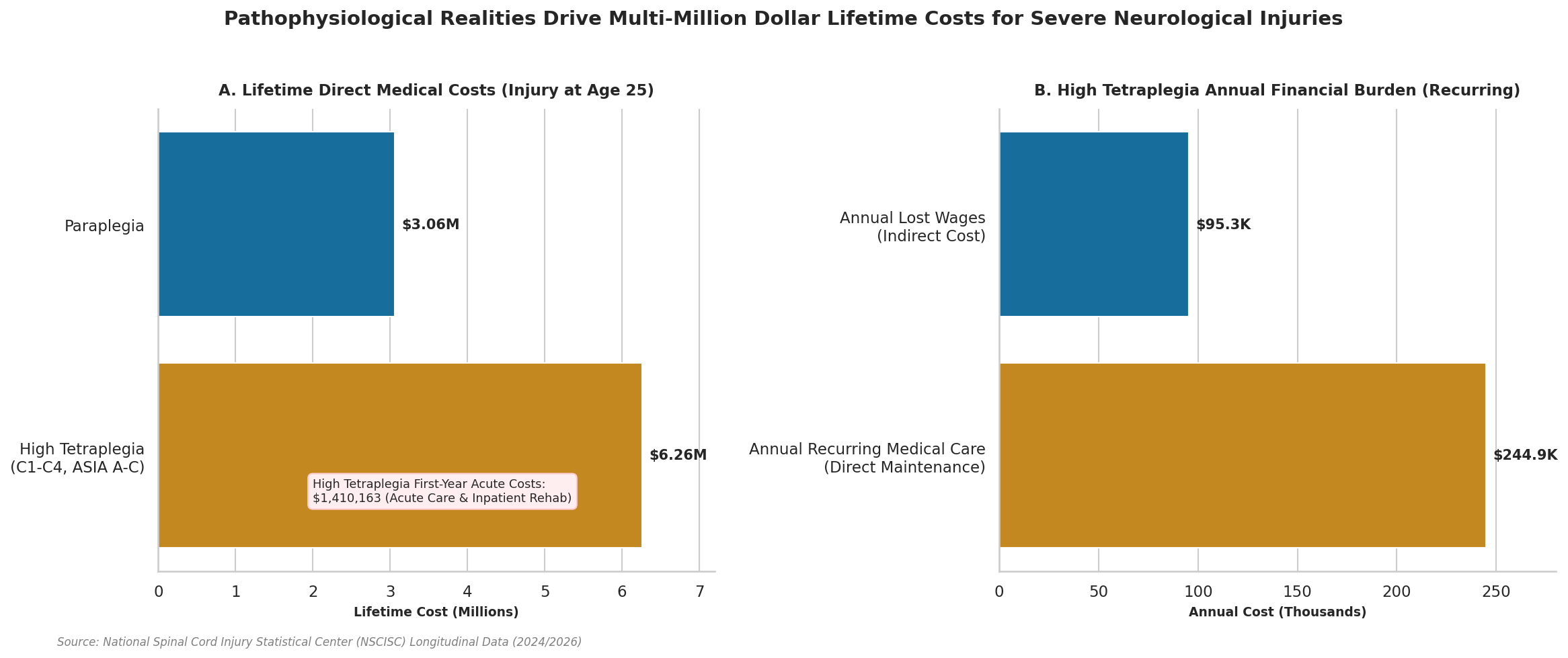
Figure: NSCISC lifetime and annual cost data by injury severity, illustrating why an individualized functional assessment, not a population average, has to drive both the life-expectancy and life-care-plan analysis.
A Life-Expectancy Opinion Should Be Built From Function, Complications, and Clinical Trajectory
An expert prognosis should not be presented as though it were simply “the average person with this injury lives a certain number of years.” The inquiry should examine, where relevant, injury level and completeness, ventilator dependence, mobility, swallowing and feeding ability, aspiration risk, recurrent pneumonia, autonomic dysfunction, seizures, pressure injuries, renal or urinary complications, cardiovascular condition, recurrent hospitalization, cognitive and functional independence, and the length of time already survived since the injury. Survival itself changes over time as evidence: a prognosis made during acute hospitalization is not necessarily equivalent to one made after rehabilitation, a year of documented survival, stabilization on chronic ventilation, or recurrent complications. The clinical trajectory, not a single number pulled from an actuarial table, is what a defensible opinion has to be built from.
Actual Death Can Replace Earlier Predictions About Future Survival
This is a genuinely sophisticated damages point that a case theory should not overlook. Where a catastrophically injured plaintiff has filed a claim based partly on projected future losses but later dies before trial from a cause unrelated to the defendant’s conduct, Pennsylvania’s Mohler v. Worley holds that actual death can displace what had previously been speculation about future life expectancy; damages for pain, emotional harm, and earnings become limited to losses actually sustained before the unrelated death. Before an unrelated death, the future necessarily requires probability. After it, at least part of what had been projected has become historically known, and that shift in the evidentiary posture is not something the case can simply ignore. This principle should not be assumed to apply identically outside Pennsylvania without jurisdiction-specific authority.
Survival Time Can Change the Claim Without Necessarily Changing Liability
Where death is essentially instantaneous, the available survival damages differ from a case involving hours or days of survival, treatment, and measurable pre-death losses, which in turn differs from prolonged catastrophic survival followed by death, where the record has to determine whether death resulted from the original trauma, a medical complication of that trauma, subsequent negligent treatment, an unrelated disease, or another independent cause. New Jersey’s Smith v. Whitaker illustrates an important limiting point relevant here: even essentially instantaneous death does not necessarily eliminate every potential theory under the state’s Survivor’s Act, although compensatory damages specifically for conscious pain and suffering still require proof of consciousness. The specific evidentiary questions involved in proving consciousness during a brief pre-death interval are addressed at length elsewhere in this firm’s published analysis; the point relevant here is narrower: duration of survival can change the available damages and the required proof without changing the underlying liability event.
Qualification and Disqualification Criteria
A matter involving disputed, shortened, or prolonged survival may warrant disciplined review where the available record supports the following:
- A clear identification of which of the four survival questions is actually at issue, death causation, lost chance of survival, projected life expectancy for a living plaintiff, or the effect of a later unrelated death, rather than a generalized survival theory.
- Where death causation is disputed, evidence connecting the alleged negligence to the death itself, distinct from evidence merely establishing that catastrophic injury occurred.
- Where a lost-chance theory is advanced, case-specific medical causation evidence rather than population-level statistics alone, since general response rates do not by themselves establish what would probably have happened to this particular patient.
- Where future life expectancy is disputed, an individualized opinion grounded in the patient’s actual functional status, complications, and clinical trajectory rather than a general population or injury-category average applied mechanically.
- A jurisdiction-specific framework, since Pennsylvania’s increased-risk doctrine, New Jersey’s Scafidi apportionment approach, and Delaware’s Cumberbatch/Anderson distinction between death causation and loss of survival opportunity are not interchangeable.
A matter does not ordinarily warrant advancement where the claimed lost chance rests on population statistics the expert cannot connect to the specific patient, where a life-expectancy projection is taken directly from a general table without individualized clinical support, or where the death-causation and catastrophic-injury-causation questions have been treated as a single issue without separate proof.
Litigation Readiness
Defense positions in this category of case commonly include the argument that death, if it occurred, resulted from an independent or preexisting condition rather than the alleged negligence, that a lost-chance expert’s opinion rests on population data rather than case-specific analysis, that a life-expectancy projection for a living plaintiff overstates the individualized clinical picture, or that a later unrelated death forecloses damages that had previously been projected as future losses. A responsible evaluation anticipates each of these positions and keeps the four survival questions analytically distinct throughout, since a theory that blurs death causation with catastrophic-injury causation, or that substitutes a population average for an individualized prognosis, is exactly where these cases become vulnerable.
Scope and Responsibility
The question a disputed-survival case raises is not simply whether the outcome was severe. It is which specific survival question the evidence actually supports, whether that question requires proof of death causation, lost chance, or individualized life expectancy, and what the record permits a qualified expert to conclude without speculation. This inquiry sits within the firm’s broader work on catastrophic injury litigation and wrongful death litigation, and it frequently requires coordinated medical, actuarial, and life-care-planning expert review before a defensible causation and damages theory can be constructed.
Referral and Case Review Inquiries
Raynes & Lawn evaluates a limited number of matters involving serious injury, institutional failure, and legally supportable theories of liability. Reviews are conducted to determine whether the medical, technical, and legal foundations required for responsible litigation are present.
Submissions may be made by individuals, families, or referring counsel. Any review is a threshold evaluation only and does not constitute acceptance of representation.